
Customer Support Sourcing for Growing Businesses
Customer support sourcing gives growing companies a more structured way to add service capacity, extend coverage, and reduce internal hiring pressure without losing commercial control of the customer experience.
As companies grow, customer conversations multiply faster than internal teams can often absorb. Response times stretch, managers become reactive, and support quality starts depending on whoever is available rather than a clearly designed service structure.
Customer support sourcing solves that problem by giving the business a disciplined path to additional team capacity. Instead of hiring locally for every new support need or coordinating multiple disconnected providers, buyers can build an offshore support function around defined roles, workflows, schedules, reporting expectations, and escalation rules.
For Tamikon Global Inc., the value is not simply access to offshore labor. The value is a structured workforce solution: clear scope, one accountable commercial relationship, centralized communication, and partner-backed delivery that helps clients scale support more cleanly.
Why customer support sourcing matters when a business starts to scale
Customer support is often one of the first functions to feel growth pressure. More leads, customers, tickets, orders, appointments, and service issues create a larger operational load before the company is ready to build a bigger local team. That makes customer support sourcing a practical growth lever when the business needs more coverage but wants to avoid unnecessary internal overhead.
Offshore support teams can help businesses extend response capacity across email, chat, ticketing, and approved voice workflows while keeping the internal team focused on higher-value service decisions.
A structured support model defines scripts, escalation rules, reporting cadence, quality expectations, and role boundaries before the team launches, reducing ambiguity as volume grows.
When customer support work is properly scoped, internal leaders spend less time chasing coverage gaps and more time improving customer experience, retention, and process performance.
Growing businesses can add capacity through a tailored monthly support structure instead of carrying the full cost and coordination burden of local hiring for every support role.
Customer support functions that are strong candidates for offshore support
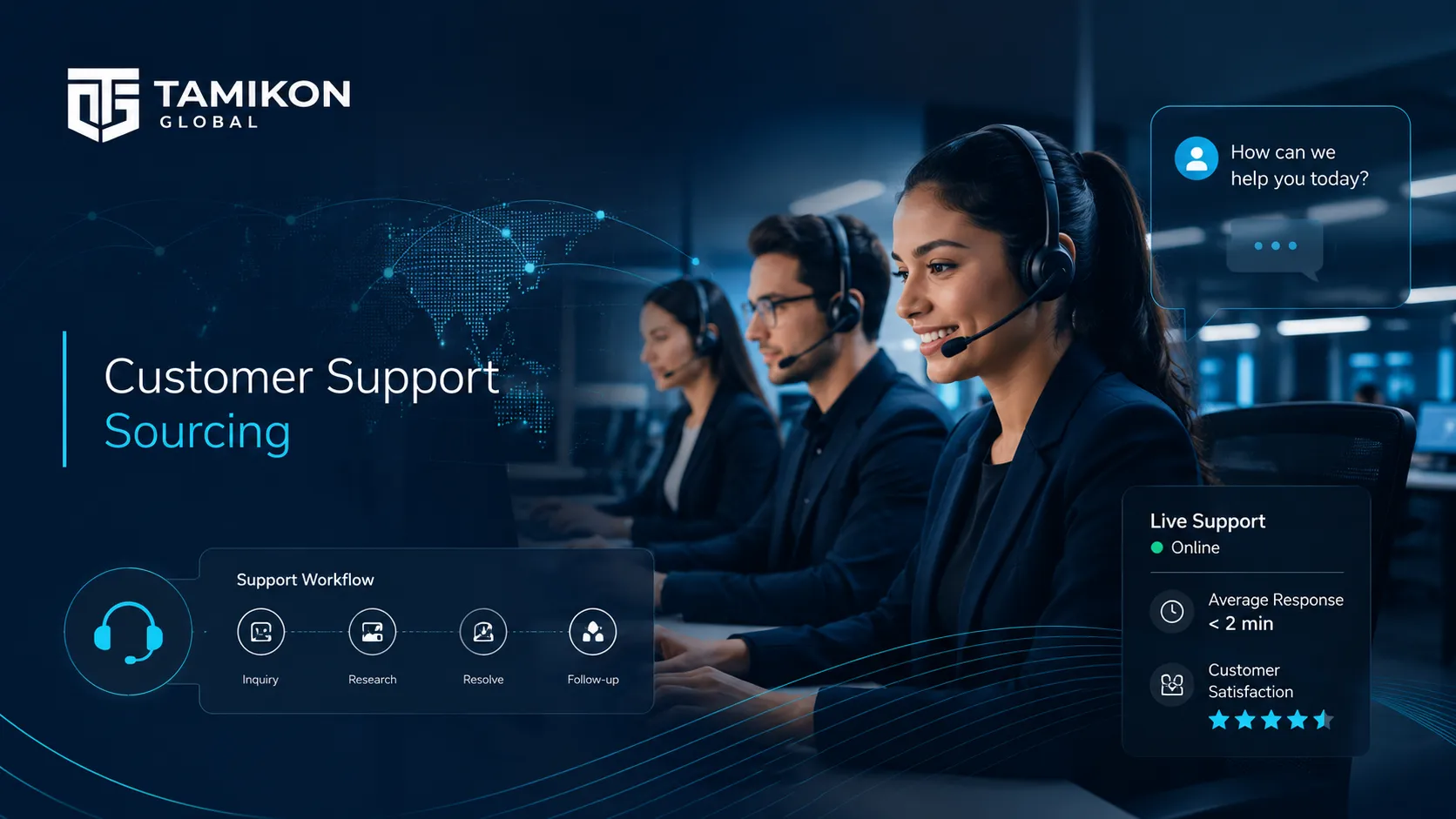
The best support functions to source are repeatable, documentable, measurable, and connected to clear customer workflows. Tamikon’s Customer Support Team services are designed around structured support roles that can be launched with defined scope and expanded as volume increases.
Email and ticket support
Useful for businesses with recurring customer inquiries, order questions, status updates, account requests, or service follow-ups that can be handled through approved response frameworks.
Chat support
Supports faster customer interaction for e-commerce, service businesses, SaaS-style workflows, appointment coordination, and front-line inquiry handling.
Voice support
Best when call flows, scripts, escalation rules, call categories, and service expectations are documented before the offshore team begins handling customer conversations.
Quality assurance support
Helps monitor interaction quality, tagging accuracy, response consistency, and adherence to approved customer communication standards.
Team lead structure
For larger support teams, a team lead can help coordinate schedules, reporting, issue routing, and day-to-day service discipline.
Back-office support tie-ins
Many support teams also need documentation, CRM updates, order tracking, and administrative coordination connected to offshore administrative support.
A better model starts with scope, not headcount
The most effective customer support sourcing engagements begin by defining what the team will actually handle. Headcount matters, but scope determines whether the engagement becomes clean, measurable, and scalable.
Tamikon’s model is built around one accountable commercial relationship with partner-backed delivery behind it. Clients get a centralized point of communication while delivery partners support recruiting, workforce administration, payroll, continuity, and related backend execution within their scope.
What buyers should clarify before outsourcing customer support
A good provider should help buyers convert a general support need into a workable service structure. Before choosing a customer support sourcing partner, decision-makers should be clear on the business problem, service model, and expectations that will shape the engagement.
Identify whether the team will support email, chat, ticketing, voice, social inboxes, CRM updates, or a combination of channels.
Confirm whether scripts, SOPs, response templates, escalation rules, and service categories already exist or need to be organized during onboarding.
Clarify required coverage windows, time zones, weekend needs, response expectations, and whether support will begin as a pilot or full team structure.
Decide what the business needs to see regularly, such as ticket volume, response activity, attendance visibility, issue categories, and quality review notes.
Start with the smallest structure that can prove the workflow, then expand role count, channels, QA, or team leadership as support demand becomes more predictable.
For general guidance on small business growth planning, buyers can also review resources from the U.S. Small Business Administration.
Customer support sourcing should make growth easier to manage.
For growing businesses, the goal is not just to add agents. The goal is to create a support structure that improves coverage, protects service consistency, and gives leadership one clear commercial relationship to manage.
Tamikon Global Inc. helps clients build scalable offshore support through clear scope, centralized communication, partner-backed delivery, and practical business outcomes.
FAQ: Customer support sourcing for growing businesses
What is customer support sourcing?
Customer support sourcing is the process of building customer service capacity through an external workforce solution. For growing businesses, it can include offshore agents, support coordinators, ticketing specialists, chat agents, voice support, QA support, and team lead structures.
When should a business consider outsourcing customer support?
A business should consider outsourcing when customer volume is rising, internal teams are overloaded, response times are slipping, or leadership wants more support coverage without adding unnecessary local hiring complexity.
What makes Tamikon’s customer support sourcing model different?
Tamikon focuses on structured workforce solutions rather than generic staffing. The model gives clients one accountable commercial relationship, clear scope, centralized communication, and partner-backed delivery support behind the scenes.
Can a company start with a small customer support team?
Yes. Many businesses begin with a small support structure, validate workflows, then expand into additional channels, shifts, quality assurance support, or team lead coverage as demand grows.
What should be documented before launching offshore customer support?
Buyers should define supported channels, role responsibilities, scripts, escalation rules, system access, reporting cadence, schedule expectations, quality standards, and service boundaries before launch.